
Go Goa Gone
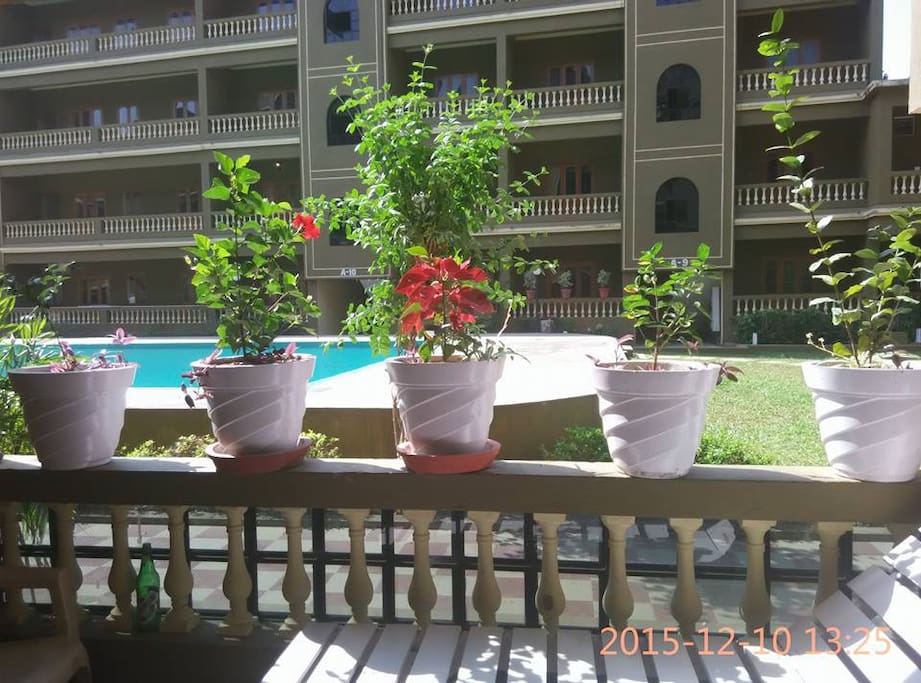
Poolside 1 BHK Apartment in Resort
Siolim, Goa, India
Serene Siolim- Gateway to the pristine beaches of North Goa at Tropical Dreams Resort with Lush green surroundings Ground Floor across the biggest swimming pool in Goa is furnished with SplitAC Ref...Vacation Rentals in Siolim
Saturday, June 12, 2010

Geography of Jammu and Kashmir State by Dr. A. N. Raina - From Satisar and Tethya sea
Geography of Jammu and Kashmir State by Dr. A. N. Raina - From Satisar and Tethya sea
Geologists believe that about ten crore years have passed when Kashmir Valley which was once a lake called Satisar, the lake of goddess Sati, came into its present form.
For hundreds of million years Kashmir Valley remained under Tethya sea and the high sedimentary-rock hills seen in the valley now were once under water. Geologists have come to believe that Kashmir Valley was earlier affected by earthquakes. Once there was such a devastating earthquake that it broke open the mountain wall at Baramulla. and the water of the Satisar lake flowed out leaving behind lacustrine mud on the margins of the mountains known as karewas. Thus came into existence the oval but irregular Valley of Kashmir.
The karewas being in fact the remnants of this lake confirm this view. The karewas are found mostly to the west of the river Jhelum where these table-lands attain a height of about 380 meters above the level of the Valley. These karewas protrude towards the east and look like tongue-shaped spurs with deep ravines.
Ancient legends and popular traditions say that Samdimat Nagar, capital of the kingdom of Sundra Sena, was submerged as a result of an earthquake, and the water that filled the area formed the Wular Lake, the largest fresh water lake in India.
The oldest igneous rocks are still found at Shankaracharya hill. When the whole Valley of Kashmir was under water this hillock was the first piece of dry land lying in the form of an igneous island.
Excerpts from:
Geography of Jammu & Kashmir State
by Dr. A. N. Raina
Radha Krishan Anand & Co.
Pacca Danga, Jammu
Minerals- The mountains surrounding the different valleys of the State of Jammu and Kashmir have varied mineral wealth.
Minerals- The mountains surrounding the different valleys of the State of Jammu and Kashmir have varied mineral wealth.
1. Lignite. It is an inferior quality of coal which is found in the valley of Kashmir at Nichahama, Baramulla, Handwara, Chowkibal, Ferozepur nullah, Nagbal, Tangmarg, Raithan, Badgam tehsil, Laligang and Lolab valley. Lignite is a blackbrown coal that is intermediate in coalification between peat and sub-bituminous coal which has a calorific value less than 8300BTU/lb, on a moist mineral free basis. According to the report of the Geological Survey of India, there are lignite coal deposits of about 5 crore 60 lakh tons in the valley. Drilling operations were started first in the Nicahhom- Chowkibal area where the reserves were estimated at 4. 5 million tons to a depth of 40 metres. Lignite is used as a fuel in the valley of Kashmir.
2. Limestone. All the three regions of the State i.e. Jammu, Kashmir and Ladakh have deposits of different ages and grades of Limestone. The Limestone of Kashmir is of high quality and is used in the manufacture of cement at Wuyan and Khrew. These deposits exist in Anantnag, Achhabal, Doru, Verinag, Biru, Sonamarg, Ajas, Wuyau, Khrew and Loduv. It is also used as building stone and mortar.
3. Copper ores are found at Aishmuqam, Shubbar area (Anantnag), Lashtil hill spurs (Baramulla), Handwara, Sumbal, Kangan and Lolab valley in the province of Kashmir.
4. Iron-ore deposits occur in Sharda (Karnah tehsil), Khrewa, Haral (Handwara), Uri tehsil, Garez (Sopore tehsil) and Lolab valley in Kashmir.
5. Gypsum. It is used for making plaster of paris and chalksticks. The Kashmir province has gypsum deposits at Lachhipora, Baramulla, Anantnag, Liddipora and Kathia Nullah (Uri). There is total reserve of about 4 million tons of gypsum in the State.
6. Ochre. It is used in paints and varnishes etc. There are extensive deposits of ochre in Nur Khawn, Ratasar and Jhaggi in the Uri tehsil. About 4 lak tons of ochre have been found in the State so far.
7. Zinc and Nickel are found at Buniyar (Baramulla).
8. Fuller's Earth is used in the manufacture of country soap and for filling paper. It is found in Rampur near Baramulla
9. Slate Stone is found in abundance in the valley of Kashmir.
10. Graphite is used in the manufacture of lead pencils and is found in Bararipora, Uri, Karnah, Malogam, Piran in the province of Kashmir
11. Sulphur is found in Pagga valley in Ladakh. In spring water, it is found at Anantnag and Khrewa. The estimated deposits of sulphur in the State are 2,00,000 tons.
12. Marble. Large deposits of marble have been found at Drugmalla, Zirahama, Oura and Trehgam in Kupwara district of Kashmir. This is light brown to dirty grey in colour. This is being used commonly in buildings these days.
Acharya Kriipalani-- eternal vigilance is the price of freedom
Acharya Kriipalani - eternal vigilance is the price of freedom
1. The concluding para of this article evokes some memories of the past. It also reinforces what I heard from Acharya Kriipalani that eternal vigilance is the price of freedom.
2.Around 1992 I had a Bihari friend who was very close to Chandra Shekhar, then the PM of India.We would often taunt him about their political clan. One day he gave a befitting rejoinder:
Jis desh ka voter he corrupt ho to politician kaise nahin na hoga. Ab dekhiye... purane zamane mein ek thho kambal dete the to pakka bhote milta tha. Aur aaj to sasura 500 rupaya le leta hai par bhote phir bhi kisi aur ko deta hai. Aisa beimaan janta ka neta beimaan nahin hoga to aur kya hoga.
We had no answer. Do you have?
3. I have a strange feeling that this article is a hoax. Several months ago I received a similar email raising similar issues and referring to panel discussion in Europe. This suspicion is reinforced by the fact that The Hindu online is not the first publisher of this article. The same article also appeared on 30/5/2010 ( a day before The Hindu) at
I therefore suspect if the genuine Mohan Murti, a resident director of reliance in europe, etc., would like to rub Indian leaders on the wrong side.
Wonder how I should go about cross checking on this piece.
Thursday, June 10, 2010
UN discussion about the Kashmir issue-- “WHOSE LAND IS IT ANY WAY?”
I want to share this story with you and the other readers. Perhaps you may have already heard about it. Once there was a meeting in UN to discuss about the Kashmir issue.
The Indian representative started to say, “Before I present the papers regarding India’s stand on this issue, I want to tell every one present here about how Kashmir got its name. More than 5000 years ago, the entire Kashmir Valley was immersed in water and was known as Satisar Lake. A Hindu Brahmin called Rishi Kashyap converted the vast lake into a beautiful valley thru’ his hard meditation and austerities and asked all the Hindu Brahmins to come and live there. It was then known as Kashyapmir (in his name) which later became Kashmir. One day when he was taking his bath in the lake, leaving his clothes on the hills of Baramulla, a Muslim guy stole his clothes”
At this point, the representative from Pakistan got up angrily and interrupted the Indian guy shouting, “Why are you accusing the Muslims? Muslims weren’t even there at that time. Islam wasn’t even born then”. The Indian representative smiled and said, “This is precisely the point I want to make, he admitted it and everybody heard him. Now you decide about Kashmir, “WHOSE LAND IS IT ANY WAY?”
And this is the point the whole non-muslim world has to make and send all of them back to the place where they originally came from—-THE BARREN DESERTS OF ARABIA!
If they were born in our lands, let them convert back to the faith of their ancestors, the original inhabitants of the land they occupy.
Friday, June 4, 2010
HISTORY OF BHADERWAH (Jammu and Kashmir)-1
HISTORY OF BHADERWAH (Jammu and Kashmir)
The place which "Mahanju Daru and Harappa" civilization has in Indian history, the same place with history of Duga Nagar and Vdho Nagar civilization has in the history of Bhaderwah.
In ancient times Bhaderwah had been a sovereign and prosperous state. These ancient cities of Duga Nagar and Audho Nagar were situated in area of village Monda and Sartingal and their capital at "Garah" Sungli. It is said that Pandavas performed the Ashwameg yajna (Horse sacrifice), the "Sham Karan" horse was taken from the then king of Bhaderwah Sawan. There was a big university here in these days having the capacity of lodging and boarding for about one thousand students.
Due to the volcanic havoc created by Kailash mountain the Dugha Nagar was buried under the heavy bounders, which still exist there. The king Udho establish another city naming Woho Nagar about one Km. away from the Dugha Nagar. This city also fell prey to natural clamity of Kailash mountains and was submerged. The cities continued to destroy but the ruling clan continued to live.
Although economically people deteriorated but king’s continued to establish new cities. When Udho Nagar submerged then king Bharat was the ruller. He then establish an other city near present power house after his name and called it "Bhadravart". These days that area is called "Bhadrot".
After that Bhadarwah was ruled by "Naga Dynasty" but after some time the rulers became weak. At that time a powerful kingdom of Bhadu Blawar existed and its rulers conquered and annexed the states of Bhaderwah Basohli to their Kingdom.
Afterwards Prince Radhk was given the state of Bhaderwah and he ruled it calling himself Raja Lakshmi Dev. This dynasty ruled Bhaderwah upto sixteen generations. During this period a noble king named Nagpal impressed Mughal king Akbar with its spiritual power and undaunted courage. The famous Mala Pat Bhaderwah is celebrated in memory of that historical event since then, when ‘Nagas" became the rulers of Bhaderwah, they shifted their capital to Bhaderwah proper called Nagar. The last king of this dynasty was "Pahar Chand".
In 1821 AD Bhaderwah became the part of J&K State. When Maharaja Partap Singh was crowned as king, Bhaderwah was given as "Jagir" to his younger brother Raj Amar Singh. Then Bhaderwah constituted the Tehsil Gandu, Tehsil Thathri, major part of Tehsil Doda in short whole of Bhalasa and left of river chanab from Thathri upto Batote.
RELIGIOUS BELIEFS
During the period when "Dugha Nagar" and Udho Nagar existed people used to pray before, Lord Brahma, Lord "Vishnu" and goddess Durga. At the later stage of the rule of these kind people were influenced by "Shive Mat". By coming of "Naga clans" its culture and civilization was effected by Nagacult. Even today all the three deities are workship and revered in Bhaderwah and Malas, Festivals are celebrated in their honour. There is a Mata Shitla temple at Rahoushra about km from Bhaderwah, where pilgrims from Hamachal Bani, Bilawar, Dudu Basantgarh and Bhadarwah go to workship the diety and get her blessing. The biggest Mala is held on 8th of Autumn Novratras, in which thousands of people participate from all parts of Bhaderwah. In the month of May a Mala is held at Malni Kansar in honour of Mata Chandi.
"mutually assured destruction" - Nuclear Warheads (Source: SIPRI - Stockholm International Peace Research Institute) -- Nuclear arsenals of India and Pakistan
"mutually assured destruction"
In its latest annual world military expenditure report released on Wednesday, the Stockholm International Peace Research Institute (SIPRI) said Pakistan's weapons-grade plutonium production would jump seven-fold with the two new reactors at Khushab nearing completion.
"Our conservative estimates are that Pakistan has 60 warheads and could produce 100 nuclear weapons at short notice," said SIPRI, adding that Islamabad had earmarked its US-supplied F-16 fighters, Ghaznavi and Shaheen missiles as its nuke delivery systems.
India's nuclear weapons programme, in turn, has largely been plutonium-based, basically centred around the Pu-239 produced in research reactors like Cirus and Dhruva at Bhabha Atomic Research Centre.
Nuclear arsenals of India, Pakistan, and even China, pale in comparison to the gigantic ones of the two former Cold War foes, US and Russia. SIPRI estimates there are a whopping 22,600 active, inactive and stored nuclear warheads around the globe, enough to destroy it several times over.
While Russia has 12,000 warheads, 4,630 of them "deployed" ones, US has 9,600, which includes 2,468 of them operational. The two have, however, recently decided to slash their inventories by nearly one-third.
France comes third with 300, followed by UK with 225. Israel, which like India and Pakistan is not a signatory of the Nuclear Non-Proliferation Treaty, completes the list of the eight countries with nuclear weapons, with an arsenal of 80 warheads. Then, there is also North Korea, which has produced "enough plutonium for a small number of warheads", SIPRI said.
All these figures are not exact because countries keep their nuclear weapons programmes in thick cloaks of secrecy, which is only now being lifted by countries like US and UK.
India has been concerned about Pakistan's drive to bolster its nuclear arsenal over the past few years. While India has a clear and declared `no-first use' nuclear weapons doctrine, Pakistan has kept it vague to use as a tool to offset India's conventional military superiority.
Moreover, there is continuing controversy in India over whether the country has a credible thermonuclear or hydrogen bomb, given that a few experts contend the 45-kiloton thermonuclear device tested under the Pokhran-II tests in 1998 was "a fizzle".
The armed forces also remain quite worried about the lack of SLBMs (submarine-launched ballistic missiles) and ICBMs (intercontinental ballistic missiles) in their armoury, which are needed for a credible deterrent and for robust second-strike capabilities against both Pakistan and China.
At present, only the short-range Prithvi missile (150-350km) and the 700km range Agni-I have been fully operationalized till now. Agni-II (over 2,000km) and Agni-III (3,500km) are still in the process of being inducted by the Strategic Forces Command. India's most ambitious strategic missile Agni-V, with a 5,000km range, in turn, will be tested for the first time only by early-2011 or so.
Nuclear Warheads (Source: SIPRI)
Russia: 12,000
US: 9,600
France: 300
UK: 225
China: 240
Pakistan: 70-90
Israel: 80
India: 60-80
Courtesy The Times of India
http://timesofindia.indiatimes.com/India/Pakistans-nuke-arsenal-bigger-than-Indias/articleshow/6005178.cms
Subscribe to:
Posts (Atom)